How to Choose Bridesmaid Dress Colors: The Complete Guide
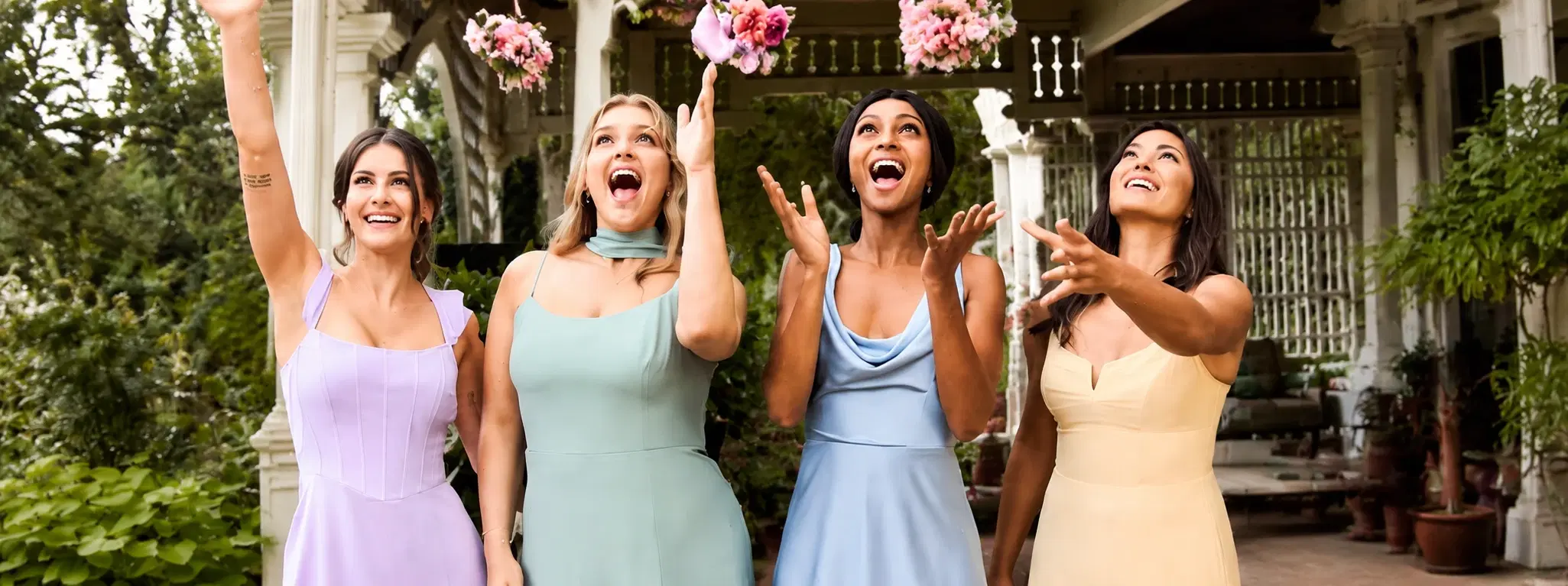
How do you choose bridesmaid dress colors? Start with three things: the season, the dress code, and the vibe of your wedding. Everything else layers in from there.
Fair warning: this decision has more voices in it than almost any other wedding decision you'll make. Your bridesmaids have preferences. Your mom has preferences. Your Pinterest board has preferences. And you're the one walking down the aisle.
Before you get into swatch-shopping, these three major factors will do most of the work of narrowing the palette.
Different seasons pull different palettes. Spring leans into fresh, softer, floral-adjacent tones (florals? For spring? Groundbreaking, we know). Summer opens up to brights, saturated jewel tones, and coastal palettes (and fun bouquet pairings). Fall pulls into warm neutrals, deep berries, olive, and terracotta. Winter reads formal—jewel tones, deep reds, moody navies, and everything black-tie-adjacent.
You don't have to color-match the fall leaves on the trees outside your venue exactly. But whatever you choose will photograph against the season's light and setting, so it's worth being intentional.
A black-tie evening wedding calls for a different bridesmaid palette than a garden brunch. Formality determines the saturation, the depth, and often the actual fabric of each dress.
Not sure what dress code you're planning yet? Start with our full wedding dress code guide for couples to lock that in before you shop for bridesmaid dresses.
Coastal, garden, urban-modern, industrial, romantic-vintage, minimalist, black-tie-glam. Every wedding aesthetic points to a distinct color language. The bridesmaid dresses are one of the biggest visual signals of your aesthetic, so they need to speak the same language as your venue, florals, and stationery.
Not sure of your aesthetic yet? Take the Pearl Planner Vision Quiz to define it before you commit to a color palette.
-606e2049-6af0-4e37-adf4-1a6c7410becc.png&w=3840&q=75)
Once you've narrowed by season, formality, and aesthetic, there’s actually three more factors to help you pick the final colors.
This is not the time to force yourself into a palette you don't love because Pinterest told you it was trending. If you've been drawn to sage for as long as you can remember, the dusty sage bridesmaid dresses in your wedding are going to make you happy every time you look back at the photos—every group shot, every processional frame, every reception photo, for the rest of your life. Start with what YOU love.
Color and skin tone interact—that's color theory, not a problem to solve. A cool jewel tone reads differently against warm undertones than against cool ones. Same for warm terracottas, sages, and dusty roses. The move isn't to pick colors that "flatter" your bridesmaids. It's to pick a palette rich enough that every bridesmaid finds her moment in it. If you're set on a single color but worried about how it reads on one bridesmaid, offer a slightly different shade from the same palette. Which is a good excuse to...
Your wedding palette probably has 4–6 colors in it (a main, a secondary, a couple of accents, a neutral). Your bridesmaid dress palette should be 1–2 of those—typically the main and secondary. Trying to make the bridesmaid dresses hold every color in the wedding palette overwhelms the visual and dilutes the moment.
Did you know? Mismatched bridesmaid dresses are 3x more popular with couples inside Pearl Planner compared to matching groups. That's nothing really new, but further proof that the same-dress-same-color days of your mom’s wedding party is fully out the window.
Mismatched doesn't have to mean chaos. Most brides who go this route pick a single color and let each bridesmaid choose her own silhouette, OR pick 2–3 shades from the same palette and assign one to each bridesmaid, OR pick a metallic or neutral tone that reads coordinated even in different silhouettes.
For the full deep-dive on this look: How to Pull Off Mix-and-Match Bridesmaid Dresses, plus our Different-Color Bridesmaid Dress Ideas inspiration page for visual reference.
-84f92aa0-51e4-4655-b658-c0849c452116.png&w=3840&q=75)
The same color can read completely differently across different fabrics. A dusty rose reads soft and matte in chiffon, structured and elevated in Mikado, and rich and moody in velvet. Whatever color you're leaning toward, factor in what fabric (or fabrics) it's going to live on.
Different seasons and formality levels also point to different fabrics. For a season-specific fabric breakdown, see our Velvet vs. Satin vs. Chiffon: Fall Bridesmaid Dress Fabric Guide.
Screens lie. That coral you saw on Instagram is not going to look the exact same in real life, on real fabric, in your specific venue's light. The single highest-leverage move you can make in the color-selection process is holding the actual fabric in your hand.
David's Bridal offers three free swatches so you can order the colors you're deciding between, hold them next to your floral inspiration or venue photos, and see them in different lights before you commit.
Once you've locked your bridesmaid palette, the next question is how it coordinates with the groomsmen. This is where a lot of couples get stuck—the color on the bridesmaid side has a name and a swatch, the color on the groomsmen side has a different name and a different swatch, and "dusty rose" from one vendor doesn't necessarily match "dusty rose" from another.
David's Bridal partners with Generation Tux specifically to solve this. You can order five free color-matched swatches through Generation Tux that align with David's bridesmaid dress colors—so ties, pocket squares, and other accessories match precisely across both sides of the wedding party. No guessing.
How to Coordinate Your Wedding Party Perfectly with Generation Tux
How to Make Tuxedo Rental Easy and Stress-Free with Generation Tux
Or start directly with Generation Tux and David's Bridal.
-2716a48a-12b3-4144-887e-3931f0d829d5.png&w=3840&q=75)
Start with three things: the season, the dress code, and the vibe of your wedding. Everything else layers in from there. Order fabric swatches before you commit—screens lie.
Popular bridesmaid palettes shift by season and by aesthetic, but consistent favorites include sage green, dusty blue, mauve/dusty rose, terracotta, champagne, navy, deep burgundy, and emerald green. See our full Bridal Party Colors inspiration page for current-season references.
Yes. Based on activity in Pearl Planner, mismatched bridesmaid dresses are 3x more popular than matching sets. Most brides who go this route pick a single palette and let bridesmaids choose their own silhouette, or assign different shades from the same color family. Full guide: How to Pull Off Mix-and-Match Bridesmaid Dresses.
The easiest way is through the David's Bridal + Generation Tux partnership. Generation Tux offers five free color-matched swatches that align with David's bridesmaid dress colors—so ties, pocket squares, and other accessories match precisely across the wedding party without cross-vendor guesswork.
Not exactly—but they should live inside the same palette. Pick one or two main colors from your full wedding color palette and put those on the bridesmaids. Trying to make the bridesmaid dresses hold every color in the wedding palette dilutes the overall visual. One or two colors, well-chosen, does the work.
Choosing bridesmaid dress colors comes down to matching the palette to your specific wedding—the season, the formality, the aesthetic, the wedding party you're dressing, and the photos you want to look back at. Order swatches before you commit. Coordinate the groomsmen side through Generation Tux. And when the palette is locked, it's locked—stop scrolling Pinterest.
Order your free David's Bridal color swatches, browse the full bridesmaid dress collection, or create your Pearl Planner dashboard to save the palette and share it with your wedding party.
Written by Andrea Pesce, Senior Copywriter at David's Bridal. Find more of her work on the David's blog.