Mix-and-Match Bridesmaid Dresses: How to Pull Off the Look
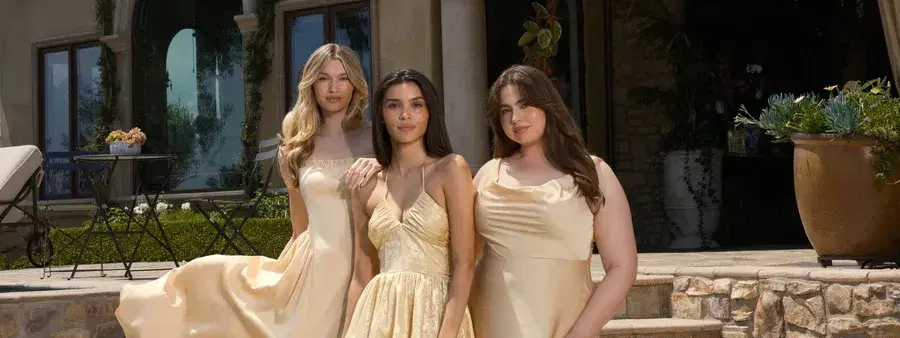
Mix-and-match bridesmaid dresses—the trend that turned "matching maids" into "coordinated maids"—is officially the new default. Every bridesmaid gets a dress that fits her body, her budget, her comfort level, and her personality. And when it's done well, the wedding party photo looks intentional, editorial, and completely yours.
But mix-and-match is not the same as "let everyone wear whatever.” (But we do love that too)! Coordinated bridesmaids need at least one unifying element to keep the photos from looking chaotic. Six popular approaches to mix-and-match, five golden rules, and what to avoid—below.
Mix-and-match bridesmaid dresses can mean a lot of different things. On the subtle end: four bridesmaids in slightly different shades of earthy greens. On the bold end: six bridesmaids in completely different silhouettes, colors, and fabrics—coordinated only by a shared aesthetic. Most weddings sit somewhere in between.
The key move: decide where on the mix-and-match spectrum you actually want to land BEFORE you send your wedding party shopping. "Whatever you want in the color family" leads to very different outcomes depending on how many bridesmaids you have and how tightly the color family is defined. Being specific upfront prevents a group chat spiral three weeks before the wedding.
For shoppable examples of every approach below—including color palettes, curated silhouette combinations, and bridal-party-tested pairings—browse David's Mismatched Bridesmaid Guide.
The easiest and most popular version that’s been the standard for the last decade. Every bridesmaid wears the same color, but each one picks the silhouette that flatters her body and matches her comfort level—one in an A-line, one strapless, one with long sleeves, one tea-length. The color unifies the group in photos; the silhouettes let each bridesmaid feel like herself in her own dress.
Best for: brides who want the party to look cohesive from a distance but personal up close. Also best for brides with a size-diverse or comfort-diverse wedding party (which is most of them).
Every bridesmaid wears the same dress in a coordinated but different color from the same palette—one in dusty rose, one in mauve, one in blush, one in cream. Works especially well for weddings with a defined color story (garden, sunset, coastal, moody, etc.).
Best for: brides who want a strong editorial photo look and are willing to hand-select the color for each bridesmaid rather than letting them pick freely.
The most editorial version. All vibe, no dress code. "Wear anything from this palette—sage, cream, dusty rose." Each bridesmaid picks her own dress within the palette. Silhouettes, fabrics, and specific colors all vary.
Best for: brides with high trust in their wedding party's style sensibilities AND genuine comfort with less control over the final look.
Not for: brides who are going to spiral if one bridesmaid picks something they wouldn't have chosen.
Every bridesmaid wears the same fabric—everyone in satin, or everyone in chiffon, or everyone in matte crepe. Colors and silhouettes are open, but the fabric coherence creates visual unity across the wedding party. Sneakily one of the strongest mix-and-match strategies because fabric photographs more consistently than color does.
Best for: brides who want editorial polish without micromanaging color.
Every bridesmaid wears a dress from the same designer or collection (e.g., all Galina Signature, all Vera Wang Bride, all Celebrate DB Studio). Colors, silhouettes, and price points can vary widely, but the design DNA of the collection creates a coherent aesthetic.
Best for: brides who want a specific brand aesthetic AND flexibility on individual choice within it.
The maid of honor wears one dress. The bridesmaids wear another. The junior bridesmaids or flower girls wear a third. Different roles = different looks. This isn't strictly "mix-and-match" but a modern approach to wedding-party hierarchy that photographs beautifully—the MOH stands out visually, the bridesmaids coordinate as a group, and the youngest members get age-appropriate silhouettes.
Best for: brides who want clear visual roles in the wedding party photos and don't mind spending slightly more time coordinating three separate looks instead of one.
Every successful mix-and-match wedding party has at least one unifying element—same color, same silhouette, same fabric, same palette, same designer. Pick yours and name it explicitly when you brief your bridesmaids. "Wear something you love" leads to chaos. "Wear anything from this palette in satin" leads to a coordinated wedding party.
Even brides doing the "pick anything" version of mix-and-match usually get better results when they curate a shortlist of 5 to 10 approved options to serve as inspiration for their bridesmaids. It respects each bridesmaid's ability to pick her own body's dress AND prevents wildly off-brand choices.
The whole point of mix-and-match is that not every bridesmaid needs to wear the exact same dress. A strapless satin gown that looks amazing on one bridesmaid might feel awful on another. Let bridesmaids opt into different silhouettes based on what actually flatters and feels good on their body. Same for budget—if you're mixing across silhouettes, mixing across price points is fine too.
Before every bridesmaid commits to her dress, create a mock-up: a Pinterest collage or a Pearl Planner Vision Board with all the chosen dresses side by side. Look at the group visually. If one dress reads dramatically different from the others in a way you don't want, catch it now. Not on the wedding day.
The one hard rule of mix-and-match: everyone needs to be at the same formality level. A ball gown next to a sundress next to a satin midi looks like three different weddings smashed together. All floor-length, or all tea-length, or all knee-length. Mix silhouettes and colors freely inside a shared formality lane.
Too many colors. Four or five different hues can work if they're all in the same palette family. Six or more different hues can read as chaotic over coordinated.
Formality mismatches (see rule 5).
Letting the wedding party pick 100% freely with zero guardrails. Even the most trusting brides usually curate at least a mood board.
Forgetting the color story of the whole wedding. Mix-and-match bridesmaids should coordinate with your flowers, linens, and overall palette—not exist in a separate visual world.
Skipping fabric consideration. Chiffon and satin photograph differently under the same light. If you're mixing colors, keep fabric coherent.
Assuming everyone will "just figure it out." They won't. Someone has to lead the coordination—usually the bride or the maid of honor.
Every bridesmaid dress purchased at David's Bridal comes with the David's Fit Guarantee™—our promise that each dress will fit exactly the way each bridesmaid wants it to on the wedding day. Whether your wedding party is in the same silhouette or six different ones, David's Alterations Artisans handle every detail from hem to bodice, and we stand by the fit until it's right.
Read more about the promise here.
Mix-and-match bridesmaid dresses have moved past "trend" and into "new default." The majority of weddings now feature some form of coordinated-not-matching wedding party looks. Fully matched bridesmaid parties are now the minority.
Most successful mix-and-match wedding parties use two to four colors from the same palette family. Five or more different colors can skew toward chaotic. If you want more variety, hold the color count to three and mix silhouettes or fabrics for additional variation.
No—but fabric coherence is one of the strongest ways to unify a mix-and-match wedding party. If you're mixing colors and silhouettes, locking in fabric (everyone in chiffon, everyone in satin) creates visual harmony that carries the photos.
Yes, but you can never go wrong with a few guardrails. The most successful "pick your own" wedding parties give bridesmaids a curated shortlist (5 to 10 approved inspiration options) rather than open-ended freedom. This respects each bridesmaid's individual style while preventing off-brand choices that don't work with the group.
Pick a unifying element and enforce it. Same color OR same silhouette OR same fabric OR same designer. Everything can vary except that one thread. Also match formality level (all floor-length, all tea-length, etc.) and stay within a coordinated palette.
Yes—David's partners with Generation Tux to color-coordinate groomsmen tuxes, suits, ties, and accessories to your bridesmaid palette. For mix-and-match wedding parties specifically, this is especially useful: whether you want the groomsmen matched to one core wedding color (regardless of which bridesmaid wears which) OR each groomsman paired individually with the bridesmaid he's walking with, the David's team can help coordinate the exact match. Groomsmen can register with Generation Tux online or in-store at any David's location.
Start with David's Mismatched Bridesmaid Guide to browse color palettes and shoppable examples of every approach above. David's Bridal offers one of the largest mix-and-match bridesmaid collections in the country, with over 40 colors and dozens of silhouettes across our Galina Signature, Celebrate DB Studio, The Edit by DB Studio, and Vera Wang Bride bridesmaid collections. Or book a bridesmaid appointment to fit your full wedding party in one visit.
The mix-and-match wedding party is the coordinated-but-personal version of the traditional bridesmaid moment. Every bridesmaid gets to wear a dress that fits her, feels like her, and works for her budget. The bride gets a wedding party that looks intentional in photos. Everyone wins.
Ready to shop? Start with David's Mismatched Bridesmaid Guide or book a bridesmaid appointment to fit your full wedding party in one visit. And use Pearl Planner to build your custom Vision Board with every dress side by side—so you can see the group photo before it's real.
Written by Andrea Pesce, Senior Copywriter at David's Bridal. Find more of her work on the David's blog.

-606e2049-6af0-4e37-adf4-1a6c7410becc.png&w=3840&q=75)
-84f92aa0-51e4-4655-b658-c0849c452116.png&w=3840&q=75)
-2716a48a-12b3-4144-887e-3931f0d829d5.png&w=3840&q=75)
