Suit vs Tuxedo for Wedding: Which is Right?
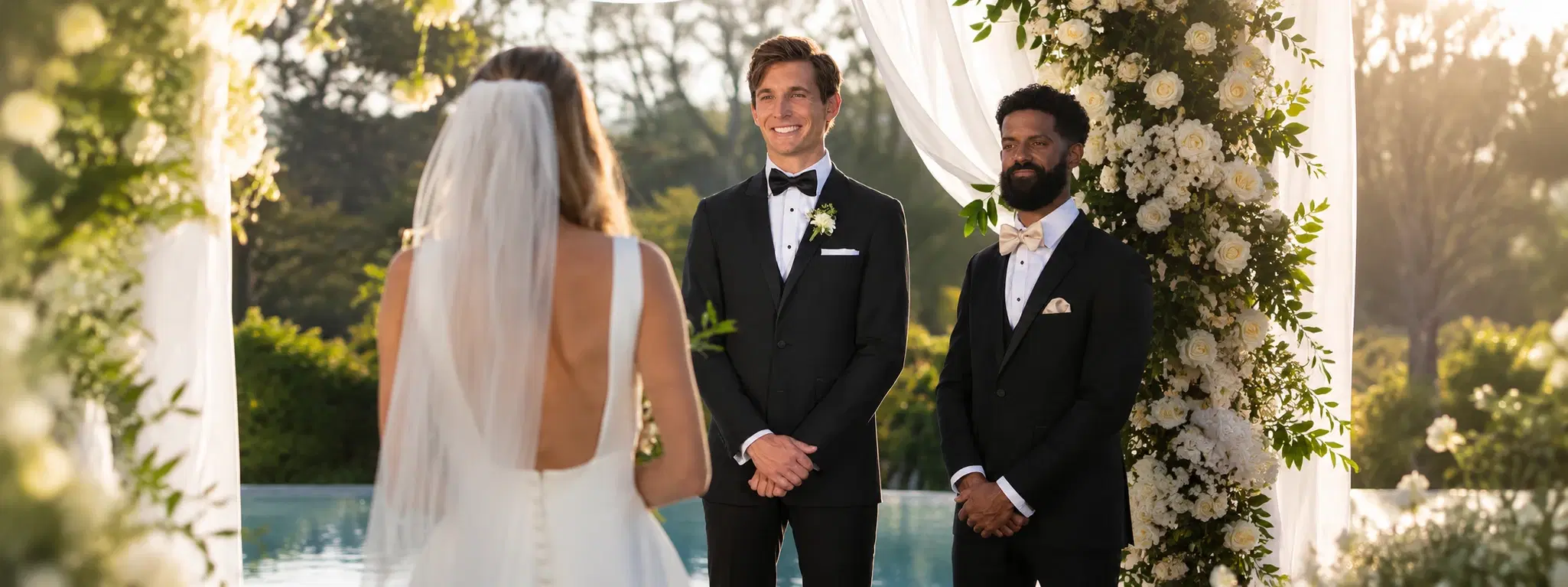
Suit vs. tuxedo for a wedding is one of the last decisions the groom actually gets to make on his own—and it's a real one. They aren't interchangeable. They send different signals. And picking the wrong one for the venue, timing, or dress code is the kind of style choice that shows up in every photo for the rest of your life.
Here's the fast version: tuxedos are for the most formal weddings, especially evening ceremonies. Suits are for daytime, outdoor, and everything below black tie. Both can look genuinely great when they fit the moment. Below, everything else you need to make the call.
A tuxedo has satin. That's the shortcut. Satin on the lapels, satin down the sides of the pants, satin-covered buttons. That's what visually separates a tux from a regular dark suit at 20 feet across a ballroom.
Other things that make a tuxedo a tuxedo: no belt loops on the pants (they fit at the waist or work with suspenders), a bow tie (never a regular necktie), a cummerbund or vest, patent leather shoes, and a pleated dress shirt that takes cufflinks. Every one of those details signals formal in a way a suit can't.
A suit is one fabric, top to bottom, without the satin. That's the visual distinction. A suit is also the more versatile piece—the one you'll wear to weddings AND job interviews AND anniversary dinners AND every other formal-adjacent moment for the next five years. Regular necktie, regular belt, regular dress shoes, regular pleated OR non-pleated shirt. Fewer required accessories, more room to interpret.
Two clear cases where the tuxedo is the right call:
The invitation says "black tie" or "black tie optional." This is not a subtle language choice—it's a specific instruction from the couple, and a tuxedo is the expected answer.
The ceremony starts after 6 PM at a formal venue. Luxury hotel ballrooms. Historic estates. Any venue that comes with chandeliers, marble, or a doorman. Tuxedos match the setting.
-606e2049-6af0-4e37-adf4-1a6c7410becc.png&w=3840&q=75)
For grooms specifically: a tuxedo also puts genuine visual space between you and every male guest in a suit. Every wedding photo you're in for the rest of your life will have exactly one groom—the guy in the tux. That distinction is worth thinking about.
Wear a tuxedo when the invitation says "black tie"—that's the whole rule. If the invitation says "black tie optional," a dark suit is a legitimate alternative but a tuxedo is still the safer bet for evening celebrations.
If you're close family or wedding party, err on the side of matching the couple's formality level even when the invitation is ambiguous. If they're going tuxedo, so are you.
A suit is the right call for most weddings that aren't specifically formal or evening-ballroom.
Daytime and early afternoon ceremonies
Outdoor and garden weddings
Beach and destination weddings—a suit reads season-appropriate; a tuxedo reads Vegas
Wineries, farms, historic barns, and other rustic-formal venues
Cocktail, semi-formal, dressy casual, and unmarked dress codes
Suits are also the investment call. A tuxedo lives in a garment bag until the next wedding you're invited to. A suit lives in your closet and shows up for job interviews, anniversary dinners, funerals (a solemn reality of adult life), and every other formal moment for the next five years.
Three suit colors work for basically every wedding scenario: navy, charcoal, and dark gray. They photograph well, coordinate with any bridal party palette, and read appropriately dressed without trying too hard.
The one color to avoid unless the couple specifically requests it: solid black. Black suits read funeral-adjacent in a way that's harder to shake than most guys realize, especially in outdoor daylight photos.
Tuxedo rentals typically run $150 to $300. Buying one starts around $500. Suits start around $300 to buy—and most guys already have one they can wear.
If you're the groom going the tuxedo route, the David's + Generation Tux partnership eliminates the rental fee entirely for you: grooms rent free when the wedding party rents through Generation Tux, and every other rental in the party gets 20% off with Diamond Loyalty. Worth knowing before you commit to a rental somewhere else.
Factor in accessories: a tuxedo requires patent leather shoes, a bow tie, a cummerbund or vest, and a pleated shirt that takes cufflinks. A suit uses everyday dress shoes, a regular tie, and a shirt you probably already own.
If you're the groom, your choice affects everyone. The groomsmen should match your formality level—if you're in a tuxedo, so are they. If you're in a suit, so are they. Nothing looks stranger in wedding photos than a groom in a tux flanked by five guys in charcoal suits.
At David's Bridal, coordinating both sides of the wedding party is genuinely straightforward. Our partnership with Generation Tux gives you up to five free color-matched swatches that align with David's bridesmaid dress colors—so ties, pocket squares, and other accessories can match precisely across the whole wedding party. No cross-vendor guessing about whether "dusty rose" reads the same on their side and yours.
For the deeper breakdown of coordinating colors and accessories across the whole wedding party, our Groomsmen Style Guide has the full walk-through.
Not inherently. Tuxedos are more formal than suits, but "more formal" isn't the same as "nicer." A well-tailored suit at a garden wedding looks more appropriate (and honestly, better) than a rented tuxedo at the same event. Nicer = right for the occasion, not higher on a formality ladder.
Not really. Black tie means tuxedo—that's the whole point of the dress code. "Black tie optional" is the compromise version, where a dark suit works if a tuxedo isn't accessible. If the invitation says "black tie" with no qualifier, rent a tuxedo.
When the invitation says "black tie." That's the primary trigger. For "black tie optional" or evening ceremonies at formal venues, a tuxedo is a strong choice but not required—a dark suit works too. For more on wedding guest dress codes broadly, see our Wedding Guest Guide.
Suits, by a lot. A quality suit works for weddings, job interviews, funerals, anniversary dinners, and your kid's big recital. A tuxedo works for other black-tie weddings and… that's mostly it. If you're buying instead of renting, a suit is the significantly smarter long-term investment.
If you're a groomsman: match the groom's formality level. Whatever he's wearing, you're wearing.
If you're a guest: follow the invitation's dress code, and if there's no dress code, take a cue from the venue. Fancy ballroom = closer to formal. Farm reception = closer to relaxed. If genuinely unsure, ask the couple or the best man; nobody minds a guest checking.
Suit vs. tuxedo isn't about which is "better"—it's about which is right for the specific wedding you're going to. Tuxedo when the invitation says black tie or the ceremony is evening formal. Suit for basically everything else. Get the fit right, coordinate with the rest of the wedding party, and you're done.
Ready to rent or shop? Explore men's suits at David's or head straight to Generation Tux for the tuxedo side. And if you're the groom, the David's + Generation Tux partnership means grooms rent free plus 20% off every rental in the wedding party with Diamond Loyalty membership.
Written by Andrea Pesce, Senior Copywriter at David's Bridal. Find more of her work on the David's blog.